UPSC Cut Off, Prelims & Mains Cutoff and Past Years Trends
UPSC Cut Off refers to the minimum marks required to clear each stage of the Civil Services Examination. Every year, the Union Public Service Commission (UPSC) releases category-wise cut-off marks for the Preliminary exam (GS Paper I), the Mains exam, and the final selection (Mains + Interview). These cut-offs vary based on factors like exam difficulty, number of vacancies, and overall candidate performance. In this article, we examine the expected UPSC Prelims Cut Off 2025 and the official cut-offs for recent years, including category-wise trends of the last five years, to help aspirants set informed targets.
UPSC Cut Off
The term UPSC Cut Off denotes the minimum score needed at each stage of the exam to advance or to make it into the final merit list. UPSC cut-offs are determined separately for each stage and for each reservation category. In other words, candidates must meet different cut-off marks in Prelims, Mains, and Final (after Interview) stages, as defined for their category (General, OBC, SC, ST, EWS, etc.). Key points about UPSC cut-offs include:
- Prelims Cut-Off: Based only on General Studies Paper I (out of 200 marks). CSAT (Paper II) is qualifying and not counted. Each category (General, OBC, SC, ST, EWS, PwBD) has its own qualifying threshold in Prelims. Scoring above this mark (e.g., 87.98 for General in 2024) means the candidate qualifies for the Mains.
- Mains Cut-Off: Determined by the aggregate marks of the seven merit papers in the Mains written exam (out of 1750 marks) – excluding the two language papers, which are qualifying only. Candidates must score above this cut-off to be selected for the Interview (Personality Test). For example, the General category Mains cut-off was 729/1750 in 2024.
- Final Cut-Off: This is the combined score of Mains (1750) + Interview (275), totaling out of 2025 marks. The final cut-off is the minimum aggregate required to be recommended for appointment. For instance, the General category final cut-off in 2024 was 947/2025 (about 46.7%).
UPSC Prelims Cut Off 2025 (Expected)
The UPSC Prelims 2025 exam was conducted on May 25, 2025. Based on initial feedback from aspirants and experts, the General Studies Paper I was of moderate to high difficulty, and the CSAT Paper II was considered quite tough. Owing to this, the expected UPSC Prelims Cut Off 2025 is projected to be in the mid-80s (out of 200) for the General category, slightly lower than the previous year’s cut-off. Some analysts predict that if the paper was particularly challenging, the cut-off could even be closer to the low-80s or high-70s, akin to the dip seen in 2023.
Expected Prelims 2025 Cut-Off (Category-wise): Early estimates for 2025 suggest the following range of scores needed in GS Paper I to clear Prelims-
| Category | Expected Cut-Off 2025 (Marks) |
|---|---|
| General | 85–90 |
| EWS | 77–82 |
| OBC | 84–89 |
| SC | 70–75 |
| ST | 66–71 |
Note: These figures are unofficial predictions based on expert analysis and past trends.
UPSC Cut Off 2024 (Prelims & Mains)
UPSC Cut Off 2024 refers to the minimum marks required by the last recommended candidate of each category in the 2024 Civil Services Exam. The year 2024 witnessed a moderate increase in cut-off marks compared to the steep drop in 2023, indicating the exam was of average difficulty. Below, we detail the category-wise cut-offs for both Prelims and Mains in 2024:
UPSC Prelims Cut Off 2024
The UPSC Cut Off 2024 represents the minimum marks needed to qualify for each stage of the Civil Services Exam — Prelims, Mains, and Final. The cut-off marks differ across categories and depend on paper difficulty, candidate performance, and vacancies.
The 2024 exam saw a moderate level of difficulty, and the cut-off slightly increased compared to the previous year. Below are the category-wise Prelims and Mains cut-off marks.
| Category | Cut Off Marks (Out of 200) |
|---|---|
| General | 87.98 |
| EWS | 85.92 |
| OBC | 87.28 |
| SC | 79.03 |
| ST | 74.23 |
UPSC Mains Cut Off 2024
The Mains 2024 cut-off was slightly lower than 2022, indicating tougher written papers. Candidates who scored around 42%–44% in Mains qualified for the interview round.
| Category | Cut Off Marks (Out of 1750) |
|---|---|
| General | 729 |
| EWS | 696 |
| OBC | 702 |
| SC | 685 |
| ST | 684 |
UPSC Prelims Cut Off Last 5 Years (2019–2023)
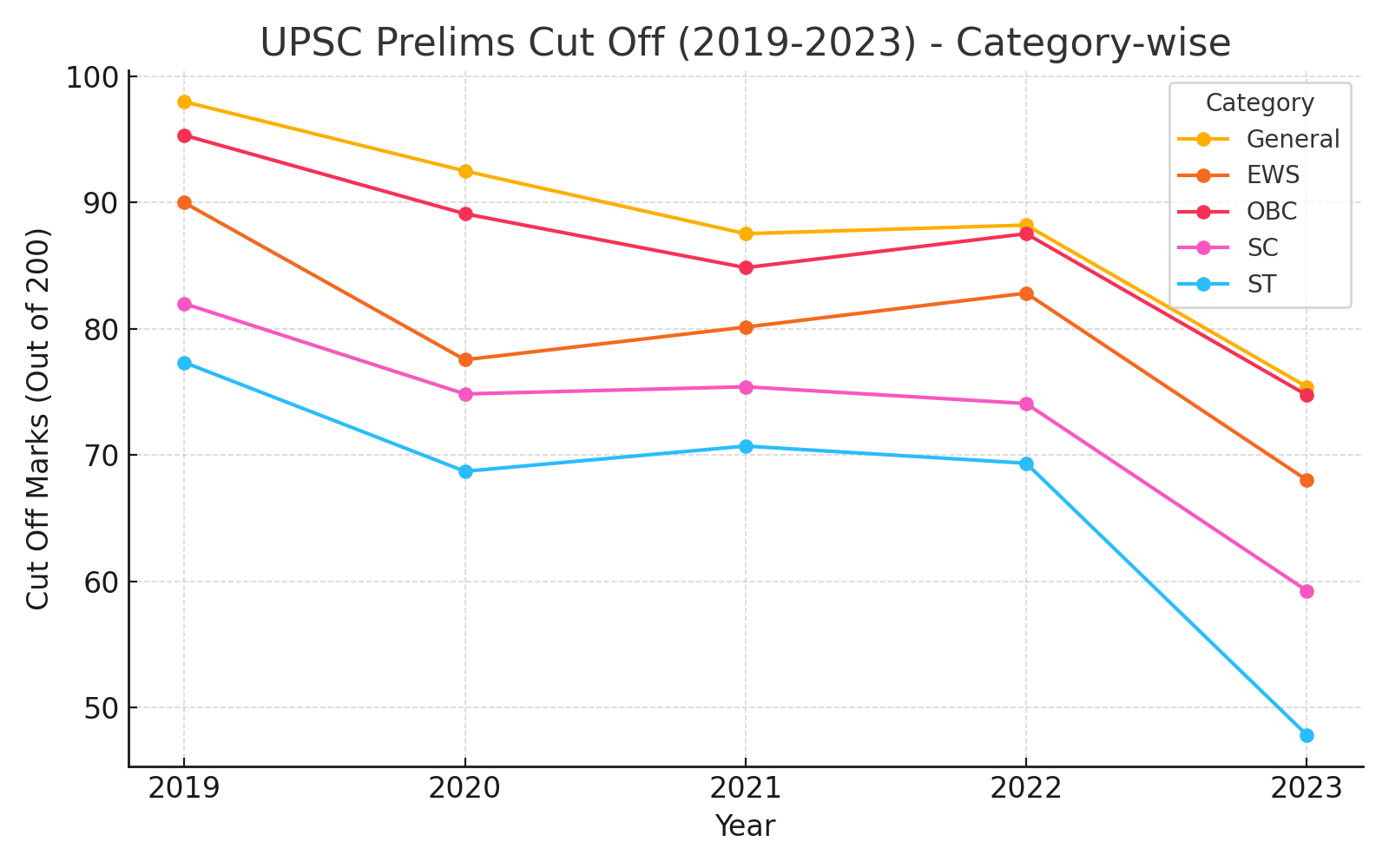
Over the past five years, the UPSC Prelims cut-off has shown considerable fluctuation, especially for the General category. The General category Prelims cut-off ranged from a high of 98 marks to a low of 75.41 marks between 2019 and 2023. The peak was in 2019 (98 out of 200), indicating an easier paper or high scoring that year, whereas 2023 saw the lowest cut-off (75.41) due to an unusually difficult exam. Most other years hovered in the mid-to-high 80s for General (e.g., 92.51 in 2020, 87.54 in 2021, 88.22 in 2022).
The table below summarizes the official UPSC Prelims cut-off marks for the last five years (2019–2023) across different categories-
| Category | 2019 | 2020 | 2021 | 2022 | 2023 |
|---|---|---|---|---|---|
| General | 98.00 | 92.51 | 87.54 | 88.22 | 75.41 |
| EWS | 90.00 | 77.55 | 80.14 | 82.83 | 68.02 |
| OBC | 95.34 | 89.12 | 84.85 | 87.54 | 74.75 |
| SC | 82.00 | 74.84 | 75.41 | 74.08 | 59.25 |
| ST | 77.34 | 68.71 | 70.71 | 69.35 | 47.82 |
UPSC Mains Cut Off Last 5 Years (2019–2023)
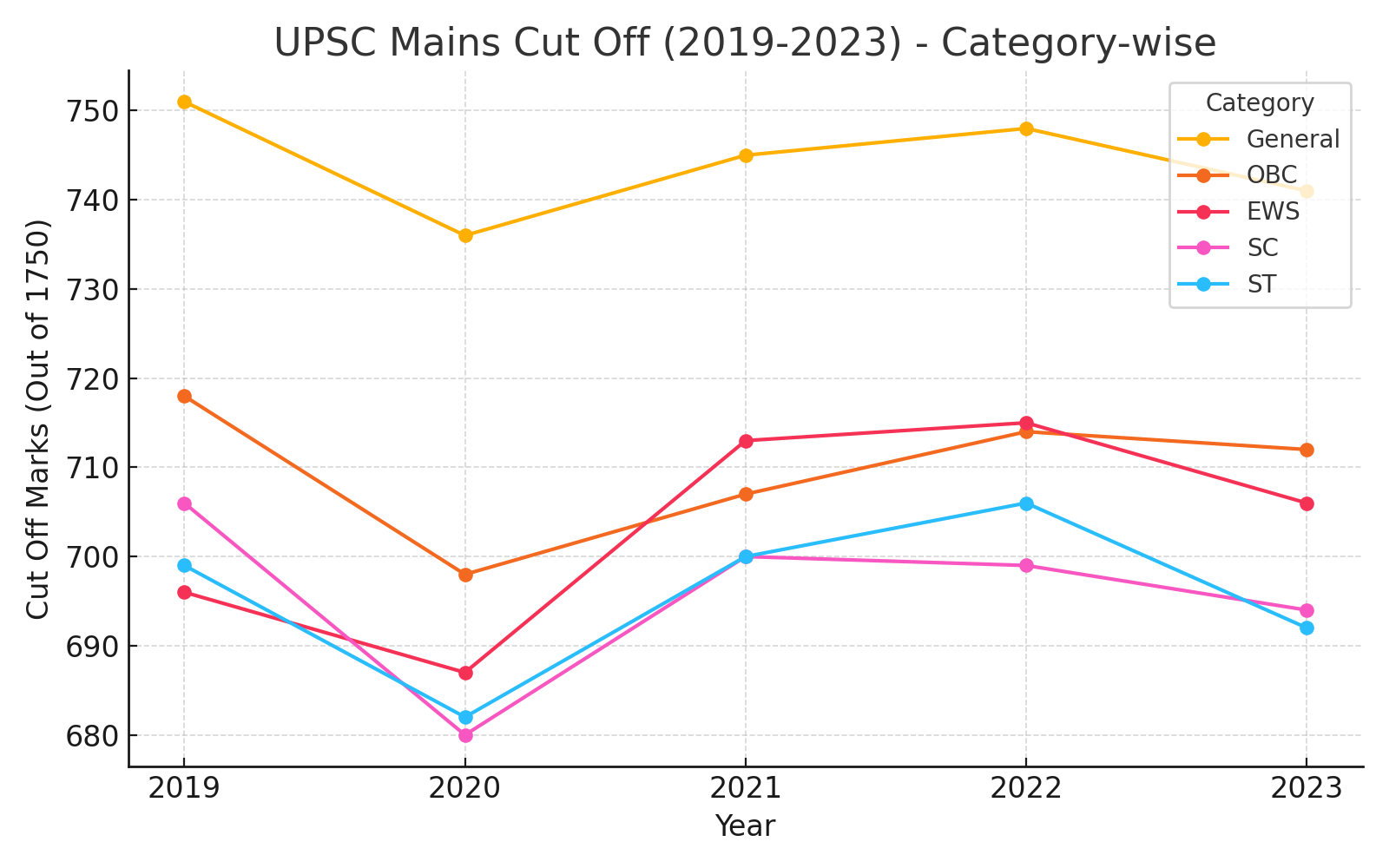
Over 2019 to 2023, the UPSC Mains cut-off (written exam out of 1750) remained relatively stable with some fluctuations. For the General category, the cut-off hovered around the low-700s each year. It peaked at 751 in 2019 and dropped to its lowest at 736 in 2020.
Below is the Mains cut-off (out of 1750) for the last five years (2019–2023) , category-wise:
| Category | 2019 | 2020 | 2021 | 2022 | 2023 |
|---|---|---|---|---|---|
| General | 751 | 736 | 745 | 748 | 741 |
| EWS | 696 | 687 | 713 | 715 | 706 |
| OBC | 718 | 698 | 707 | 714 | 712 |
| SC | 706 | 680 | 700 | 699 | 694 |
| ST | 699 | 682 | 700 | 706 | 692 |
UPSC Final Cut Off Last 5 Years (2019–2023)
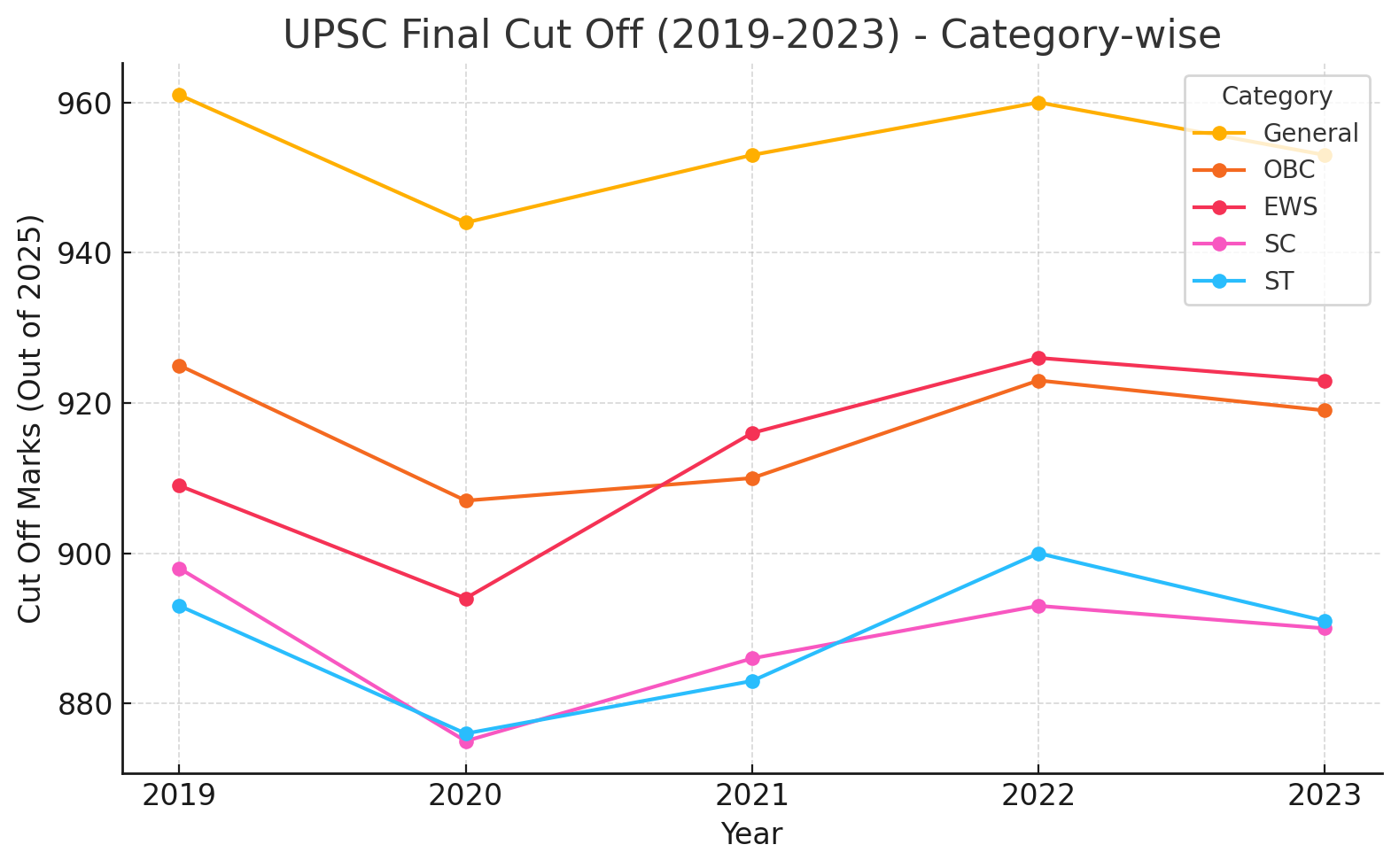
The Final UPSC Cut Off is the aggregate score of Mains and Interview (out of 2025) required for final selection into the Civil Services. Over the last five years, final cut-offs have been remarkably consistent and high. For the General category, the final cut-off has consistently been in the 940–960 range. In numbers, General cut-offs were: 961 (2019), 944 (2020), 953 (2021), 960 (2022), and 953 (2023). This means a General candidate typically needs about 46–47% of the total 2025 marks to secure a service.
The table below shows the Final (Mains + Interview) cut-off marks for 2019–2023 for the main categories:
| Category | 2019 | 2020 | 2021 | 2022 | 2023 |
|---|---|---|---|---|---|
| General | 961 | 944 | 953 | 960 | 953 |
| EWS | 909 | 894 | 916 | 926 | 923 |
| OBC | 925 | 907 | 910 | 923 | 919 |
| SC | 898 | 875 | 886 | 893 | 890 |
| ST | 893 | 876 | 883 | 900 | 891 |
Factors Affecting UPSC Cut Off
Several factors influence where the cut-off marks settle for any given year and category. Understanding these can help aspirants plan their strategy:
- Difficulty Level of the Exam: If the Prelims or Mains paper is more difficult, fewer candidates score high marks, resulting in a lower cut-off. For example, the 2023 Prelims cut-off dropped due to a tough CSAT and GS paper. Conversely, an easier paper can raise the cut-off.
- Number of Candidates Appearing: A higher turnout of serious candidates increases competition. When more candidates perform well, the cut-off tends to increase. If fewer candidates or fewer well-prepared candidates appear, cut-offs might be lower.
- Number of Vacancies: UPSC cut-offs are directly related to how many openings are available. In years with more vacancies, the cut-off may be slightly lower since more candidates can be accommodated. Fewer vacancies generally tighten the cut-off.
- Overall Performance of Candidates: If the overall performance (scores) of candidates is better in a particular year, the cut-off will rise. Essentially, cut-off marks represent the score of the “last” candidate who gets through – better average performance pushes that boundary upward.
- Reservation Category: Cut-offs vary by category due to the reservation policy. The General category usually has the highest cut-off. Reserved categories (EWS, OBC, SC, ST, PwBD) have their own lower cut-offs depending on the relaxation and the performance of candidates in those categories. However, the differences are often narrow, especially between General and OBC/EWS, as seen in recent trends.
- CSAT Qualifying Nature: In Prelims, Paper-II (CSAT) is qualifying (33% required) and does not count towards the cut-off. But if CSAT is extremely difficult, many candidates might fail to qualify it, indirectly lowering the effective pool of candidates for GS Paper I cut-off. In such cases, even the GS cut-off could be impacted (like in 2023 when CSAT was a hurdle for many).
These factors collectively determine the UPSC cut-off each year. Aspirants need to note that cut-offs are post-facto figures – one should aim well above the previous cut-off to be safe. For instance, given the unpredictability of paper difficulty and competition, scoring 10–15 marks above the last known cut-off in Prelims and a comfortable margin in Mains is often advised to ensure selection.